
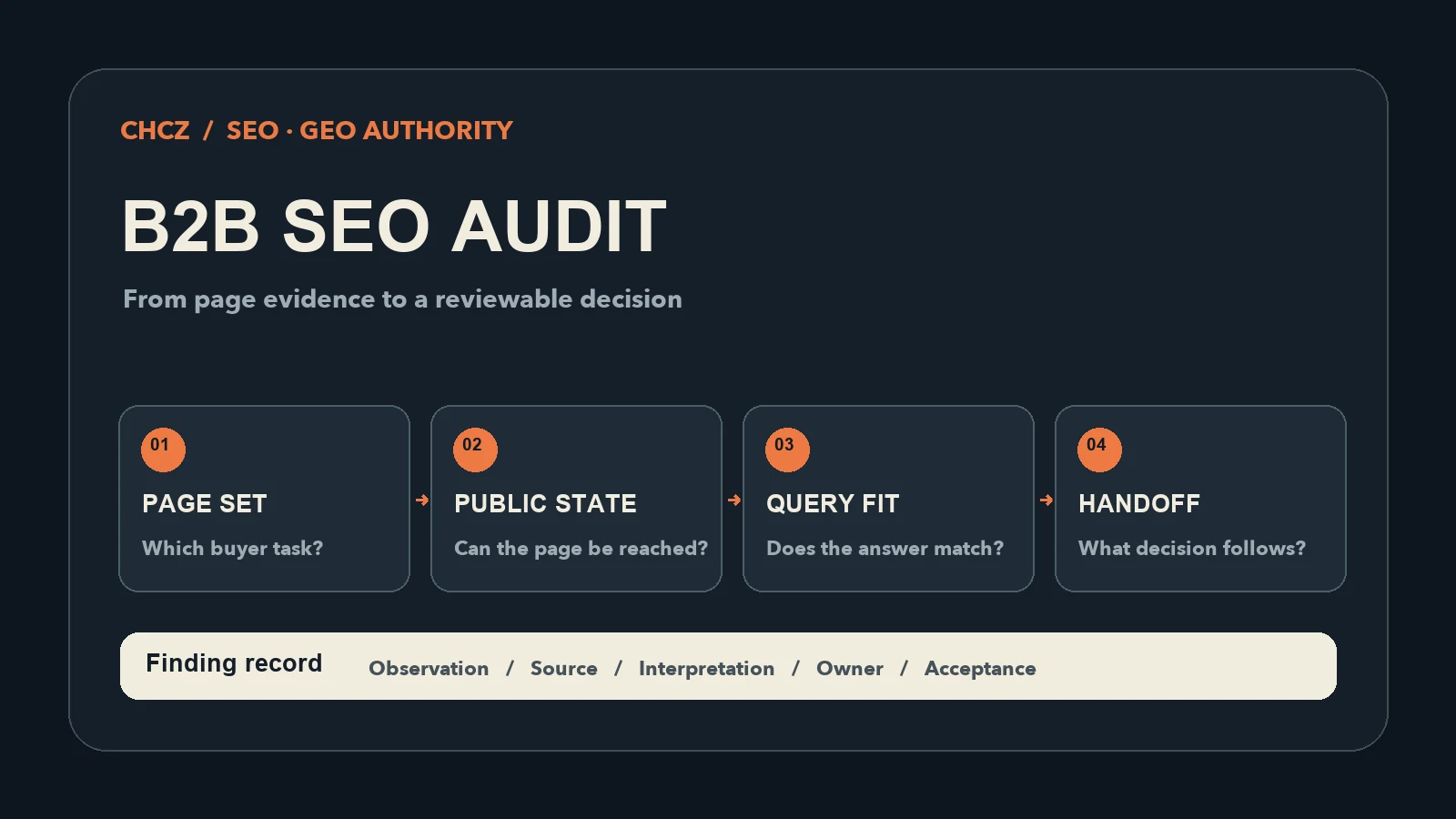
In short: a B2B SEO audit is a documented check of whether important buyer questions can lead to reachable, distinct pages and a useful next decision. Start with the pages that matter to the buyer, confirm their public and indexing state, compare their query evidence with their actual answers, inspect the handoff to another page or inquiry, then record a finding with its source and verification step. An audit is complete when another person can reproduce the diagnosis and decide what to do next.
This guide is for the marketing lead, SEO owner, or website manager who needs to assess an existing B2B site before commissioning more content or changing a long list of title tags. It provides a working checklist and a copy-ready audit record. It does not assume access to a paid crawler, a particular analytics stack, or a known conversion rate. Google’s description of Search separates crawling, indexing, and serving; an audit should likewise avoid treating one successful check as proof of the next. See How Google Search works.
Define the audit decision and page set
First write down the decision the audit must support: for example, whether a service page is discoverable and answers a buyer’s comparison question, whether several articles compete for the same question, or whether visitors have a meaningful route from explanation to a diagnostic request. A sitewide score cannot answer these questions by itself. State the market, language, search type, date range, and the person who will accept the findings.
Build a small inventory of buyer-critical URLs: the principal service pages, decision guides, category or topic hubs, relevant proof or requirement pages, and the contact route. Add the page’s intended job and its next useful step. Sampling important templates is often more actionable than exporting every tag archive and treating every URL as equal. If a page’s role is unclear, flag that as a question before assigning it a keyword.
- Scope: market, language, device, search type, observation dates, and page types.
- Decision: the buyer task the audited pages should support.
- Inventory: intended canonical URL, page role, owner, and planned next step.
- Evidence limits: access you do not have, recent releases, known data gaps, and pages deliberately kept private.
If the question is how to allocate topics before pages exist, use the B2B SEO strategy framework. This audit instead tests what the public site and its records actually show today.
1. Verify public delivery before interpreting rankings
Open each priority URL as an unauthenticated visitor. Record the HTTP response, visible main answer, title and description, mobile usability, robots directive, declared canonical, and whether the page is linked from a relevant route. Check an XML Sitemap as a discovery signal, not as proof of indexing: Google says inclusion alone does not mean a URL will be crawled or indexed. See its Sitemap guidance.
Use Search Console’s URL Inspection tool for a key page when access is available. Its indexed view and live test answer different questions: one describes Google’s known indexed version; the other tests the current reachable page. Record the inspection date, last crawl when shown, Google-selected canonical, and any difference from the declared canonical. A recent site edit may be public before Google has processed it. Do not label a fresh change a search failure simply because the inspection record is older.
When duplicate URLs exist, identify the intended representative and inspect signals consistently. Google’s canonicalization documentation recommends a preferred canonical URL and consistent internal linking to it. A canonical tag is a signal; Google may choose a different URL. Record both the site declaration and the Google-selected version where available.
2. Test query-to-page fit with dated evidence
For each priority page, write the buyer question it should answer in one sentence. Then compare that sentence with the visible heading, opening answer, examples, evidence, and next step. A page can be indexable yet answer a different question from the one that produced its impressions. Conversely, a page with little Search Console data may still serve a valuable buyer task; absence from a query table does not prove absence of demand.
In Search Console Performance, filter to the relevant country, device, search type, and date range. Inspect both the query and page dimensions, then check whether one query is distributed across multiple URLs. Google’s data-grouping documentation notes that anonymized queries and row limits can omit terms from the table, and much performance data is assigned to canonical URLs. Save the exact filters and exported row date. Treat the table as observed evidence, not a complete map of every search.
Compare a live result sample for a small set of important queries. Note whether searchers are being shown a checklist, service page, comparison, product documentation, or a direct answer. This is an intent and format observation; it does not tell you why any competitor ranks. The strongest audit finding states the mismatch concretely: “our page offers a general introduction, while the sampled query asks for implementation requirements,” rather than “content score is low.”
Where two CHCZ pages appear to answer the same buyer task, select an owner for editorial review before creating a third. Where the search task differs, make that boundary visible in the page and its links. The internal linking audit handles individual link instances after the page roles are settled.
3. Inspect the answer and its evidence
Read the page as the buyer would. Can someone understand the problem, apply the method, see the relevant constraints, and decide what to do next without leaving to search for missing basics? A page that repeats a tool’s exported warnings may not explain whether a warning affects a buyer-critical URL. The audit should identify missing decision information, unsupported claims, stale examples, inaccessible diagrams, and links that no longer lead to the promised source.
Inspect visible and machine-readable information together. The title, H1, main answer, author, image description, and Article data should describe the same page. Google’s Article structured-data guidance explains that markup can help Google understand an article; it does not make inaccurate or thin text authoritative. A successful validator result is a markup check, not a content-quality verdict or proof of rich-result appearance.
Separate fact from editorial judgment in the finding. “The page declares a canonical to another URL” is directly testable. “This canonical may be suppressing the intended owner” is an inference that needs Search Console and content comparison. “Rewrite the page for the buyer’s evaluation task” is an editorial recommendation. Keeping these three statements separate makes the audit reviewable.
4. Check discovery and the buyer handoff
From the sampled pages, follow the actual internal route to the next distinct decision: from a problem guide to an implementation guide, from requirements to provider evaluation, or from a resolved question to a diagnostic request. Check that the destination is public, in the correct language, and canonically owned. Google’s link guidance describes ordinary <a href> links as the reliable crawlable form and recommends descriptive anchor text. The buyer value of a particular route is an editorial decision that should be tested in the rendered page.
Do not mistake a navigation menu or a Sitemap entry for a contextual handoff. Equally, do not add a contact button where a reader still needs specifications or comparison evidence. If a link is missing, use the narrower buyer-path link audit to document source, anchor, target and acceptance. This broader SEO audit records the resulting gap, not every link instance.
When the journey reaches a form, check the real public interaction and destination. Record whether a submission was actually tested, whether the language route remains correct, and whether the site has a reliable way to distinguish a submitted request from a qualified inquiry. Google explains that Search Console measures pre-visit search activity, while Analytics measures onsite behavior; their counts need not match. See Google’s comparison of the two systems. A form view, Search impression, and qualified lead are separate observations.
5. Record findings so another owner can act
Use one record per material finding. The following fields are a CHCZ editorial template, not a Google requirement or a scored industry standard. Copy it into a sheet or ticket system and leave an item Unknown when evidence is unavailable.
- Page and task: public URL, intended canonical, buyer question, and page owner.
- Observation: exact rendered behavior or query/page row, with date, filters, and source URL or screenshot.
- Type: delivery, indexing, intent fit, answer evidence, internal handoff, or inquiry measurement.
- Interpretation: fact, inference, or editorial opinion; note what would falsify the inference.
- Buyer consequence: the decision or next step the issue could obstruct, without inventing lost revenue.
- Action and owner: proposed edit, reviewer, dependencies, and any protected claim needing approval.
- Acceptance: exact public check after release and the later readback date for search observations.
For example: “The service page returns 200 and is linked from the hub, but its first screen describes our process without answering the evaluation question visible in the sampled query. The query sample is dated; whether this mismatch explains low clicks is unproven. Editorial owner to draft a direct answer; reviewer to confirm claims. After release, check public title, answer, canonical and mobile view; later compare the same query and page filters after Google recrawls.” This is a decision record, not a claim that any particular change will increase rankings.
Once the audit is complete, pass the finding list to the post-audit prioritization guide. It addresses dependencies, sequencing and acceptance across findings. Tool choice is a separate question covered by the SEO audit tools comparison.
Frequently asked questions
Do I need a paid SEO tool to perform this audit?
No. Public page checks and Search Console can establish many important facts. A crawler or third-party keyword tool may help with coverage and demand estimates, but its report does not replace inspecting the affected URL or deciding which buyer task matters. Mark unavailable evidence as Unknown and keep the finding narrow.
Is an indexed page a successful SEO page?
Indexing shows that Google can include a page in its index; it does not establish query relevance, clicks, useful onsite behavior, or a qualified request. Audit those layers separately. If a recent update has not been recrawled, record that timing before judging its search impact.
How often should a B2B SEO audit run?
Choose a cadence from the site’s release pace and decision risk. A migration, new service architecture or unexplained search change warrants a focused review; routine monitoring can watch previously accepted checks between larger audits. There is no universal interval that proves the work is complete.
Finish with a reproducible decision
A useful B2B SEO audit leaves the team with a dated set of page-level facts, bounded interpretations, named owners, and a way to verify each change. The SEO / GEO Authority hub connects this audit with strategy, link review, prioritization and monitoring. If the audit shows that the site answers the right questions but the route to a diagnostic is unclear, the next step is to review the buyer journey, not to claim a traffic outcome that has not been measured.
Evidence boundary: the cited Google documents support statements about Search stages, Search Console reports, canonicals, links, Sitemaps, structured data and measurement differences. The buyer-task sequence and audit ledger are CHCZ editorial methods. No observed project outcome, personal audit experience, ranking lift or lead increase is claimed. Sources checked 2026-10-01.
Bring a decision, not just a score
If your team has a few priority URLs and an unresolved buyer-path question, bring them to a B2B growth diagnostic. We can discuss which findings need firmer evidence and who should own the next check.