

A stunning visual design might win awards, but it won’t close a complex B2B deal. Many organizations invest heavily in aesthetics, treating their website like a static digital brochure, only to wonder why it generates no meaningful leads. They forget that in the B2B space, a website is not just a visual asset; it is your single most powerful marketing and sales tool.
The best b2b website designs are not just seen; they are experienced. They function as a strategic engine designed with one core purpose: to guide a high-value, professional audience through a complex decision-making process. This requires a fundamental shift in thinking—away from “How does it look?” and toward “How does it work?”
This guide outlines the strategic blueprint for building a B2B website that truly performs. We will move beyond visual trends and focus on the architecture of conversion: defining a clear mission, integrating robust B2B content marketing, and designing for trust, usability, and measurable growth.
Defining the Core Mission: What Is Your B2B Website Built to Do?
Before a single pixel is designed, you must define the strategic purpose of your site. Your website must be your hardest-working employee, laser-focused on achieving specific business objectives. For B2B, these objectives are rarely “impressing visitors.” Instead, they are about building a predictable pipeline and establishing authority. If you cannot articulate your site’s primary mission in a single sentence, you are not ready to build it.
Moving Past the “Digital Brochure” Model
The old B2B model was a “digital brochure”—a static site with an “About Us” page, a “Services” list, and a “Contact Us” form. This model is obsolete. Why? Because it places the entire burden of action on the buyer. It assumes they already know what they need and are ready to contact you.
The modern B2B buyer is 70-80% of the way through their research before they ever contact a sales rep. If your site only offers a contact form, you have missed 80% of the conversation. The mission must shift from presenting information to guiding the user. Your site must anticipate their questions, address their pain points, and provide value before asking for anything in return.
Establishing Your Site as a 24/7 Lead Generation Engine
The primary mission of most B2B websites is lead generation. But “lead generation” means more than a “Contact Us” link. It means creating a system that captures interest and nurtures potential clients at every stage of awareness.
The best B2B website designs are built to convert different types of intent. This requires a tiered system of offers:
- Top-of-Funnel (TOFU): Low-friction offers for visitors who are just starting their research. This is where your B2B content marketing strategy begins.
- Examples: Gated whitepapers, industry reports, checklist downloads, or webinar registrations.
- Middle-of-Funnel (MOFU): Offers for visitors who understand their problem and are now evaluating solutions.
- Examples: In-depth case studies, product comparison guides, or free assessment tools.
- Bottom-of-Funnel (BOFU): Clear calls-to-action for visitors ready to engage with your team.
- Examples: “Request a Demo,” “Schedule a Consultation,” or “Get Pricing.”
Building Authority and Trust with Your Target Audience
In B2B, the sales cycle is long, and the stakes are high. Your audience isn’t buying a product; they are investing in a partnership that could impact their company’s operations, revenue, or security. Their primary question is: “Can I trust you?”
Your website’s mission, therefore, is to manufacture trust. This isn’t achieved with flashy animations. It is achieved through the systematic presentation of authority. Your site must prove that you are the definitive expert in your niche. This includes prominently featuring case studies, client logos, certifications, detailed service methodologies, and original, insightful thought leadership. If your site does not scream “expert,” your design has failed, no matter how beautiful it is.
Fueling the Funnel: Integrating B2B Content Marketing at Every Stage
If your website’s mission is its compass, then B2B content marketing is the engine that drives it forward. The best B2B website designs are, at their core, sophisticated content delivery platforms. They are built to attract, educate, and convert qualified leads by offering substantial value at every step. Without a content strategy, your website is just an empty, albeit beautiful, shell.
This strategy goes far beyond a simple “blog.” It involves a deliberate, multi-format approach to address the specific pain points and questions your ideal customers have. This is how you capture demand and build the authority that leads to high-value sales.
Mapping Content to the B2B Buyer’s Journey
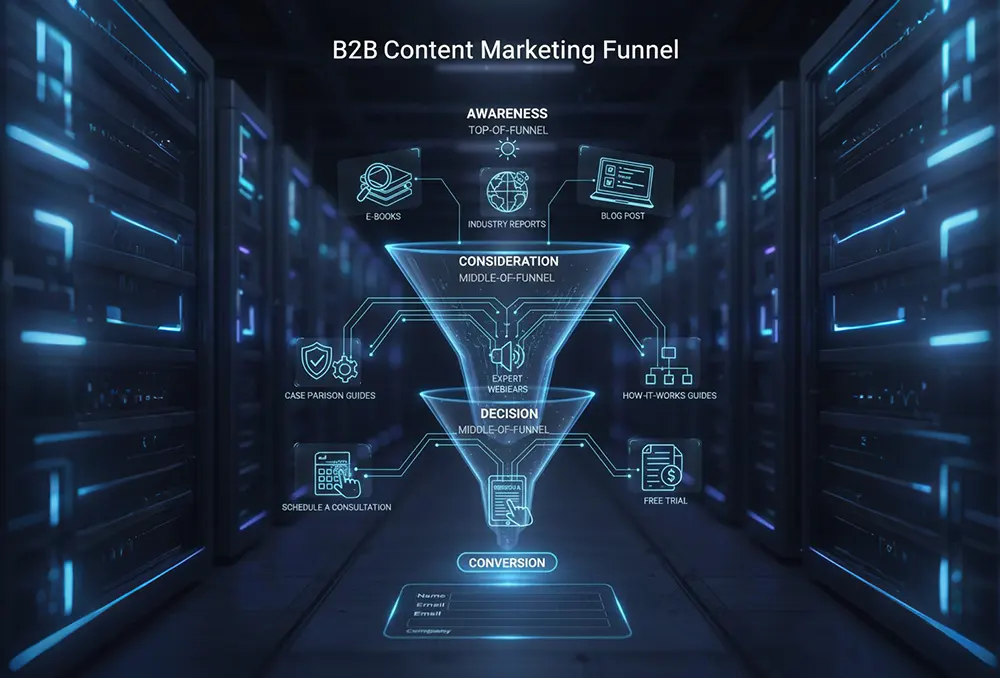
The B2B buying process is not a single event; it’s a journey. A visitor in the initial “Awareness” stage has very different needs than one in the “Decision” stage. Your content must meet them where they are.
- Awareness Stage (Top-of-Funnel): The buyer is experiencing a problem but may not know how to define it or what solutions exist. Your content here should be educational, diagnostic, and vendor-neutral.
- Content Types: Blog posts answering “What is…” or “How to…” questions, industry trend reports, checklists, and eBooks.
- Consideration Stage (Middle-of-Funnel): The buyer has defined their problem and is now researching different solutions and vendors. Your content must demonstrate your specific expertise and methodology.
- Content Types: Detailed case studies, solution comparison guides, expert webinars, and in-depth “how-it-works” guides.
- Decision Stage (Bottom-of-Funnel): The buyer is ready to choose a partner. Your content must remove final barriers, build ultimate trust, and make it easy to engage.
- Content Types: Implementation guides, pricing breakdowns (if applicable), free trial offers, or “Request a Demo” landing pages.
Developing High-Value Assets
Your most powerful content assets are those that require a higher investment of time and expertise, often referred to as “gated” content (requiring an email for access). These are the workhorses of your lead-generation engine.
The best B2B website designs feature these assets prominently, not as an afterthought. They are presented as solutions in themselves. A case study is not just a story; it is proof that you can solve a specific, high-stakes problem. A whitepaper is not just an article; it is authoritative research that defines a problem and frames your solution as the most logical answer. A webinar is not just a video; it is direct access to your top experts. Your website design must “sell” these assets as effectively as it sells your services.
Optimizing for Search Intent, Not Just Keywords
This is where strategy and SEO merge. Many companies chase high-volume keywords, like our primary keyword “best b2b website designs.” However, the real conversions often come from long-tail, high-intent keywords that reveal a specific problem.
For example, a visitor searching for “best b2b website designs” is likely in the Awareness or early Consideration stage. But a visitor searching for “how to increase lead quality from manufacturing website” is much further down the funnel.
Your B2B content marketing strategy must target these specific, problem-based queries. Your website’s structure (its information architecture) must be organized to provide clear answers to these questions. This approach has a dual benefit: it attracts highly qualified organic traffic and immediately demonstrates your expertise by solving a problem, not just selling a service.
Strategic Design: When Visuals Serve Usability and Conversion
Finally, we arrive at the design itself. In B2B, strategic design is not about decoration; it is about facilitation. The “best” design is the one that most effectively connects the user (with their problem) to your content (your solution) and guides them toward a conversion (your mission). Visuals must serve usability, clarity, and trust above all else.
Clarity and Intuitive UX: The Foundation of Good Design
A B2B buyer is busy, professional, and impatient. They will not “explore” your site to find what they need. If they cannot find their answer within seconds, they will leave and go to a competitor.
Clarity and intuitive User Experience (UX) are paramount. This means:
- A Simple Navigation: Your main menu should be dead simple. “Services,” “Solutions,” “Resources” (for content), “Case Studies,” “About,” and “Contact.” Avoid clever, branded terms that confuse users.
- A Clear Visual Hierarchy: Use size, color, and spacing to guide the user’s eye to the most important element on the page (usually the call-to-action or the value proposition).
- Unambiguous CTAs: Your buttons should say exactly what they do. “Download the Whitepaper” is infinitely better than “Learn More.” “Request a Demo” is better than “Submit.”
- Mobile-First Functionality: Your B2B buyers are checking your site on their phones between meetings. Your site must be flawless, fast, and easy to use on a mobile device.
Building Credibility: Social Proof, Trust Signals, and Clear Value Propositions
This is where design directly supports your mission of building trust. A professional, clean, and modern design implies a professional and modern company. But you must be explicit.
Your design must integrate “trust signals” on every relevant page, especially home and service pages. These are non-negotiable elements for the best b2b website designs.
- Social Proof: Prominently display logos of well-known clients, testimonial quotes, and (most importantly) full-length case studies.
- Trust Badges: Show any industry certifications, security compliance badges (like SOC 2 or ISO), or awards.
- Clear Value Proposition: Above the fold, on your homepage, you must answer three questions in three seconds: Who you are, what you do, and why you are the best choice.
Designing for the Decision-Making Unit (DMU)
You are never selling to just one person. You are selling to a Decision-Making Unit (DMU) or buying committee. This unit may include:
- The Researcher: (e.g., a junior manager) who needs detailed guides and whitepapers.
- The Technical Buyer: (e.g., an IT Director) who needs implementation docs and security specs.
- The Economic Buyer: (e.g., a CFO or VP) who needs to see case studies, ROI calculators, and pricing.
Your website design and content structure must cater to all of them. This means having clear pathways for each persona. For example, a “Solutions” dropdown might have options for “By Role” or “By Industry,” allowing different members of the DMU to find the exact content that speaks to their specific pain points.
Measuring Success: Metrics That Matter for B2B Growth
A strategic website is a measured website. You cannot improve what you do not measure. But again, the metrics for B2B are different. “Traffic” is a vanity metric; “qualified conversions” is what matters. Your analytics must be set up to track the health of your sales funnel, not just your visitor count.
Analyzing Lead Quality vs. Lead Quantity
It is easy to generate 1,000 “leads” by offering a generic, low-value download. It is much harder—and more valuable—to generate 10 high-intent “Demo Requests.” Your analytics must differentiate between these.
Set up different conversion goals for your TOFU, MOFU, and BOFU offers. Assign a lead score or value to each. A “Whitepaper Download” might be a 5-point lead, while a “Consultation Request” is a 100-point lead. This allows you to focus your marketing and sales efforts on what is actually driving revenue, not just filling a database.
Conversion Rate Optimization (CRO) Basics for B2B
Your website is never “finished.” It is a living hypothesis that must be constantly tested and improved. Conversion Rate Optimization (CRO) is the practice of methodically testing changes to your site to increase the percentage of visitors who take a desired action.
Start simple. A/B test your most critical conversion points:
- The headline on your homepage.
- The call-to-action button color or text on a service page.
- The number of fields in your “Request a Demo” form (fewer is often better).
- The layout of your case study landing page.
By making small, iterative, data-backed improvements, you transform your website from a static cost center into a dynamic, compounding growth asset. This strategic, results-driven approach is the true secret behind the best b2b website designs.