
A B2B website redesign should begin with an evidence-backed decision model, not a mood board. The audit must show which buyer tasks the current site fails to support, which conversion paths leak intent, which pages deserve to be kept or consolidated, and which technical constraints the redesign must improve without destroying existing search value.
This matters because the website often carries a large part of the evaluation before a prospect speaks with sales. In its 2025 B2B Buyer Experience study, 6sense reports findings from more than 5,000 participants across three markets and says buyers complete roughly two-thirds of the buying journey—including choosing preferred vendors—before engaging sellers. The precise pattern will vary by market, but the implication is durable: a redesign is not only a visual project. It is a buyer-enablement and measurement project.
The conclusion: audit decisions, not pixels
A useful pre-redesign audit should answer four questions:
- What business outcome is the website expected to support?
- What must a qualified buyer understand, verify, and do before making contact?
- What evidence shows where the current website helps or obstructs that journey?
- Which changes are justified now, and which assumptions still require testing?
If the audit cannot connect a proposed design change to one of those questions, the change belongs in an idea backlog—not in the approved redesign scope.
What a pre-redesign audit is—and is not
A B2B website design audit is a structured comparison between the outcomes the site must support and the evidence available from the current experience. It combines buyer research, content analysis, search data, analytics, accessibility checks, and technical measurements.
It is not a single automated score. Lighthouse, crawling tools, heatmaps, and SEO platforms can each expose useful signals, but none can decide whether the page answers the right commercial question or gives the right buyer enough confidence to take the next step. Tools detect conditions; teams make decisions.
The audit should also preserve uncertainty. “We do not yet know” is a valid finding when the current measurement is incomplete. Turning an assumption into a test is more valuable than presenting an unsupported opinion as a design requirement.
The six-layer B2B website audit framework
1. Business outcome and measurement
Begin by defining the outcome in operational language. “Generate more leads” is too broad. A better definition explains what a qualified inquiry is, which actions indicate meaningful intent, where the inquiry is stored, and how the team will connect it to its acquisition source.
Create a measurement map before reviewing layouts:
- Outcome: the business result the website should support.
- Primary conversion: the action that creates a reviewable inquiry or opportunity.
- Supporting actions: meaningful steps such as viewing a relevant service, opening a diagnostic form, or downloading decision material.
- Required context: source, landing page, content path, device, geography when appropriate, and form or booking outcome.
- Owner: the person responsible for reviewing data and acting on it.
Google Analytics lists generate_lead as a recommended event for a submitted form or request for information. That does not make the implementation correct by itself; the event should fire only after the action succeeds, and the team should test whether the event, inquiry record, and notification agree. See Google’s recommended events documentation.
2. Buyer tasks and message clarity
Next, identify what buyers are trying to accomplish at each stage. The GOV.UK Service Manual recommends learning who users are, what they are trying to do, how they do it now, and what problems they experience. It also warns that opinions not grounded in user evidence should be treated as assumptions to test.
For a B2B website, the task map might include:
- recognize that the provider understands the buyer’s market and problem;
- understand the service without decoding internal jargon;
- compare approaches and decide what evidence is credible;
- identify scope boundaries, dependencies, and next steps;
- share a useful page with technical, commercial, or executive stakeholders;
- contact the provider with enough context for a productive conversation.
Review every priority page against those tasks. A strong page has a clear audience, a clear question, a defensible answer, visible evidence, and a next step that matches the buyer’s level of readiness. CHCZ’s existing guide to strategic B2B website design explains why that structure matters beyond aesthetics.
3. Conversion paths and trust
A conversion audit follows complete paths, not isolated buttons. Start with the landing page and continue through navigation, proof, form completion, confirmation, storage, notification, and follow-up ownership.
For each path, verify:
- the call to action describes what will happen next;
- the surrounding copy resolves the main reasons a qualified buyer might hesitate;
- proof is specific, attributable, and appropriate to the claim;
- the form requests only information needed for the next step;
- errors are understandable and do not erase entered information;
- the confirmation state is unambiguous;
- the inquiry reaches a durable record and the correct owner.
Do not infer success from a button click. A click can occur even when the form fails, the notification is lost, or the inquiry is never reviewed.
4. Content, search demand, and discoverability
Export the existing URL inventory before changing information architecture. Record each page’s title, canonical URL, purpose, target audience, search demand, internal links, backlinks when available, conversions, and decision: keep, improve, merge, redirect, or retire.
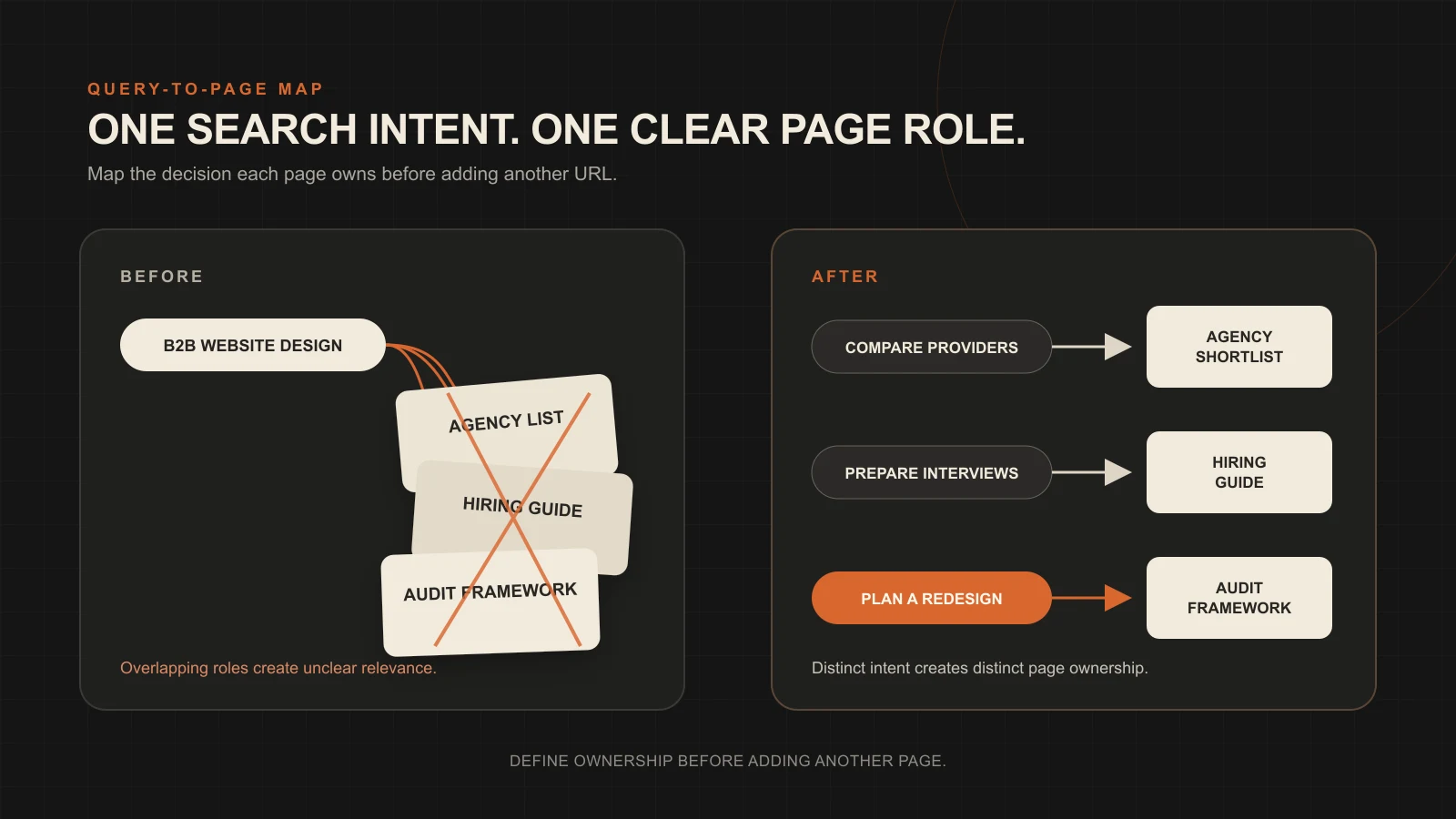
Then map search queries to pages. Google’s Search Console Performance documentation explains that the query dimension can reveal expected and unexpected searches and that page data is generally assigned to the canonical URL. Look for:
- high-impression queries whose current page does not match the intent;
- several pages competing for the same query family;
- commercial questions with no credible decision-support page;
- important pages with no relevant internal links;
- outdated titles, descriptions, dates, sources, or screenshots.
Preserve useful URLs where possible. When a move is justified, define the one-to-one redirect and update internal links. Google’s link best practices recommend standard <a href> links and descriptive anchor text so people and crawlers can understand the destination.
Content roles must remain distinct. A shortlist page serves a different decision from a methodology page. Buyers comparing providers can use the existing B2B web design agency shortlist; buyers preparing interviews can use the guide to hiring and evaluating a web designer. The audit framework should support those pages, not imitate them.
5. Accessibility and interaction quality
Accessibility belongs in discovery because it changes content, component, and acceptance requirements. The W3C Web Content Accessibility Guidelines 2.2 provide testable, technology-independent success criteria and recommend using the current version when updating accessibility policies.
At minimum, test priority templates and complete conversion paths for:
- meaningful heading order and page titles;
- keyboard navigation and visible focus;
- labels, instructions, errors, and status messages in forms;
- text and interface contrast;
- text alternatives for meaningful images;
- reflow and zoom without loss of information;
- touch-target usability on relevant mobile layouts.
An automated scan can identify some conditions, but manual keyboard checks and task-based testing are still required. Record the page, component, criterion, evidence, severity, and retest result for each issue.
6. Performance and technical resilience
Separate field evidence from lab diagnostics. Field data describes experiences from real visits when enough data exists; lab tests help reproduce problems and catch regressions before release. Neither should be presented as the other.
Google’s documented “good” Core Web Vitals thresholds are Largest Contentful Paint at or below 2.5 seconds, Interaction to Next Paint at or below 200 milliseconds, and Cumulative Layout Shift at or below 0.1, evaluated at the 75th percentile. The Core Web Vitals methodology explains both the thresholds and their field-data basis.
The technical baseline should also cover:
- HTTP status, redirects, canonical tags, indexability, and sitemap inclusion;
- rendered headings, links, and critical content;
- image dimensions, formats, alternative text, and loading behavior;
- third-party scripts and their business owner;
- form delivery, spam handling, confirmation, and recovery;
- analytics, consent, and privacy requirements approved by the responsible owner;
- structured data that matches visible content.
For articles, Google recommends markup that identifies the author and a URL that uniquely represents that author. See the Article structured data documentation. Structured data should describe the page accurately; it is not a substitute for clear authorship or useful content.
Turn findings into an evidence matrix
Raw audit output becomes useful when every finding is traceable to evidence and a decision. A compact matrix can use these fields:
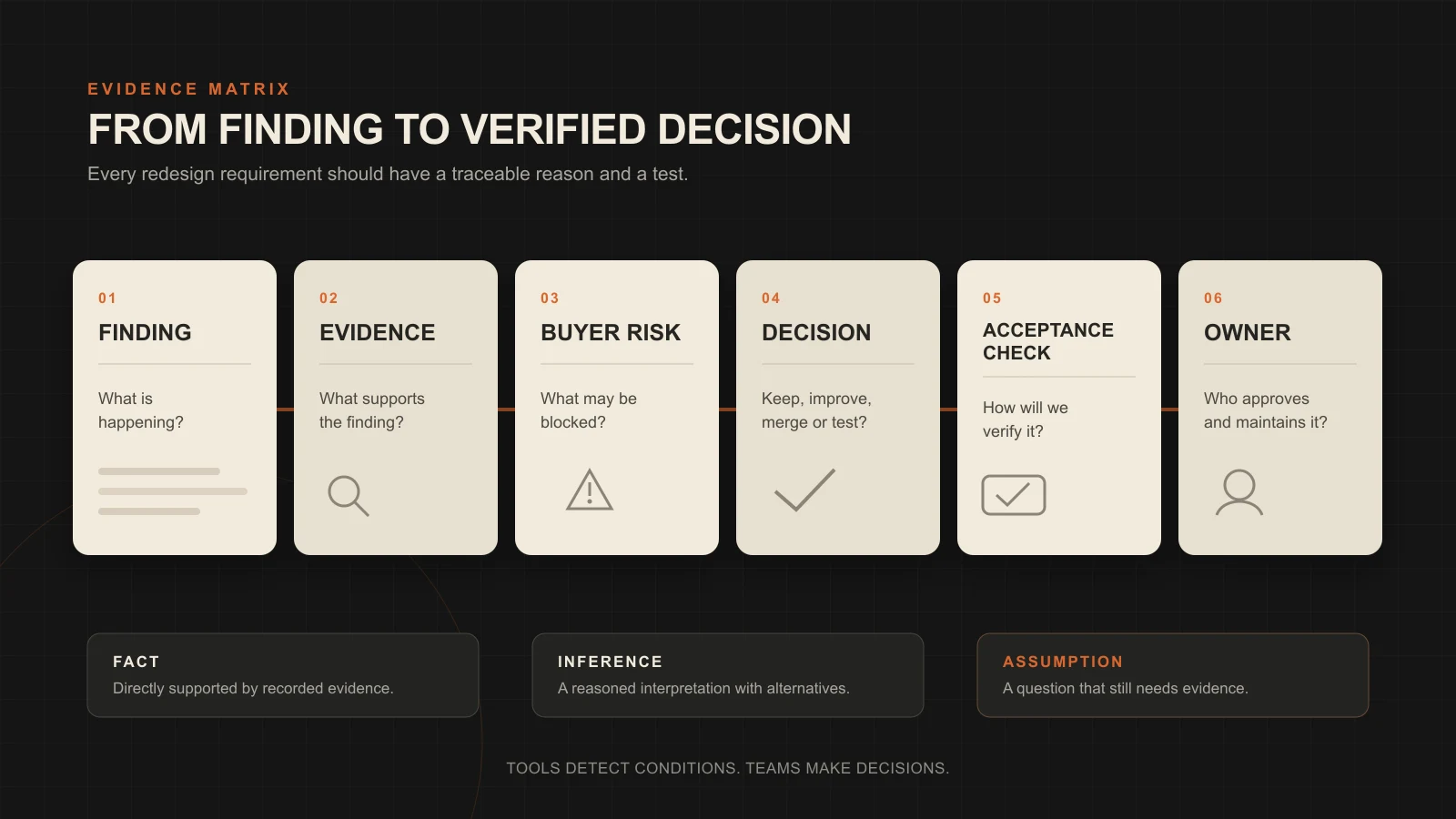
| Field | Question |
|---|---|
| Buyer task | What is the visitor trying to accomplish? |
| Observed condition | What happens on the current site? |
| Evidence | Which query, event, recording, interview, test, or page supports the finding? |
| Risk | What buyer or business outcome may be affected? |
| Decision | Keep, improve, merge, redirect, remove, or test? |
| Acceptance check | How will the team verify the change? |
| Owner | Who approves and maintains it? |
Use explicit labels such as fact, inference, and assumption. A fact is directly supported by the evidence recorded. An inference is a reasonable interpretation that may have alternatives. An assumption is a question awaiting evidence. This distinction prevents redesign scope from becoming a collection of confident-sounding guesses.
Prioritize by buyer risk, evidence, and reversibility
Do not let the longest issue list define the roadmap. Prioritize findings using three practical dimensions:
- Buyer risk: does the issue block understanding, verification, access, or a meaningful next step?
- Evidence strength: is the issue observed in reliable data or only suspected?
- Reversibility: can the team test a small change before committing to a structural rebuild?
High-risk, well-supported findings should shape the redesign brief. High-risk findings with weak evidence should become research or experiment tasks. Low-risk preferences should not outrank failures in conversion, accessibility, measurement, or content clarity.
The minimum evidence pack before design begins
A decision-ready redesign brief should include:
- Outcome and measurement brief: primary outcome, events, inquiry flow, owners, and verification steps.
- Buyer-task map: priority audiences, questions, objections, evidence needs, and next steps.
- URL and content inventory: current purpose, performance signals, internal links, and keep/merge/redirect/retire decision.
- Query-to-page map: one clear primary role for each important topic and intent.
- Conversion-path record: task flow, form states, delivery, confirmation, and ownership.
- Accessibility and performance baseline: test method, affected templates, evidence, and acceptance criteria.
- Decision and hypothesis backlog: what is approved, what needs validation, and what is explicitly out of scope.
Give the same evidence pack to every shortlisted partner. Ask each team to explain what it would preserve, what it would change, what evidence is missing, and how it would validate the result. This makes proposals easier to compare than portfolios alone.
Common audit mistakes
- Starting with the new sitemap: information architecture should follow buyer tasks and content decisions.
- Using traffic as the only success measure: visibility, inquiry completion, qualification, and follow-up are different stages.
- Treating all clicks as conversions: verify the complete delivery chain.
- Replacing URLs without a content map: a prettier structure can still destroy accumulated relevance and links.
- Testing only the homepage: buyers often enter on articles, service pages, tools, and shared deep links.
- Publishing unsupported proof: every client, result, quote, and performance statement needs approval and a verifiable source.
- Calling a lab score a user outcome: technical measurements and commercial outcomes answer different questions.
Frequently asked questions
Does every B2B website need a full redesign?
No. The audit may show that the highest-value work is a focused change to positioning, navigation, content, forms, measurement, or performance. A rebuild is justified only when the evidence points to structural constraints that smaller changes cannot resolve safely.
Is a technical SEO audit enough before redesign?
No. Technical SEO can reveal crawl, indexation, metadata, link, and performance conditions. It does not establish buyer needs, message quality, proof requirements, inquiry handling, or sales ownership. Those layers must be audited together.
Who should participate in the audit?
Include the people who own the business outcome, talk with prospects and customers, maintain content, operate analytics, build the site, handle inquiries, and approve accessibility, privacy, or legal requirements. The exact group depends on the organization, but no single discipline has all the evidence.
How long should the audit take?
There is no responsible universal duration. Scope depends on the number of templates and languages, the reliability of analytics, the complexity of conversion paths, the availability of research participants, and the evidence required for decisions. Define the questions first, then estimate the work needed to answer them.
Final takeaway
The purpose of a pre-redesign audit is not to prove that a redesign is necessary. It is to replace aesthetic assumptions with a traceable set of buyer needs, evidence, decisions, and acceptance checks.
Start with the business outcome. Map buyer tasks. Verify complete conversion paths. Preserve useful search equity. Test accessibility and performance with the right methods. Label uncertainty honestly. Then give designers and developers a brief that explains not only what to build, but why each requirement exists and how the team will know it works.
If your team needs help turning a scattered website wish list into an evidence-backed redesign brief, review the CHCZ B2B website strategy service or start a website diagnosis conversation.