
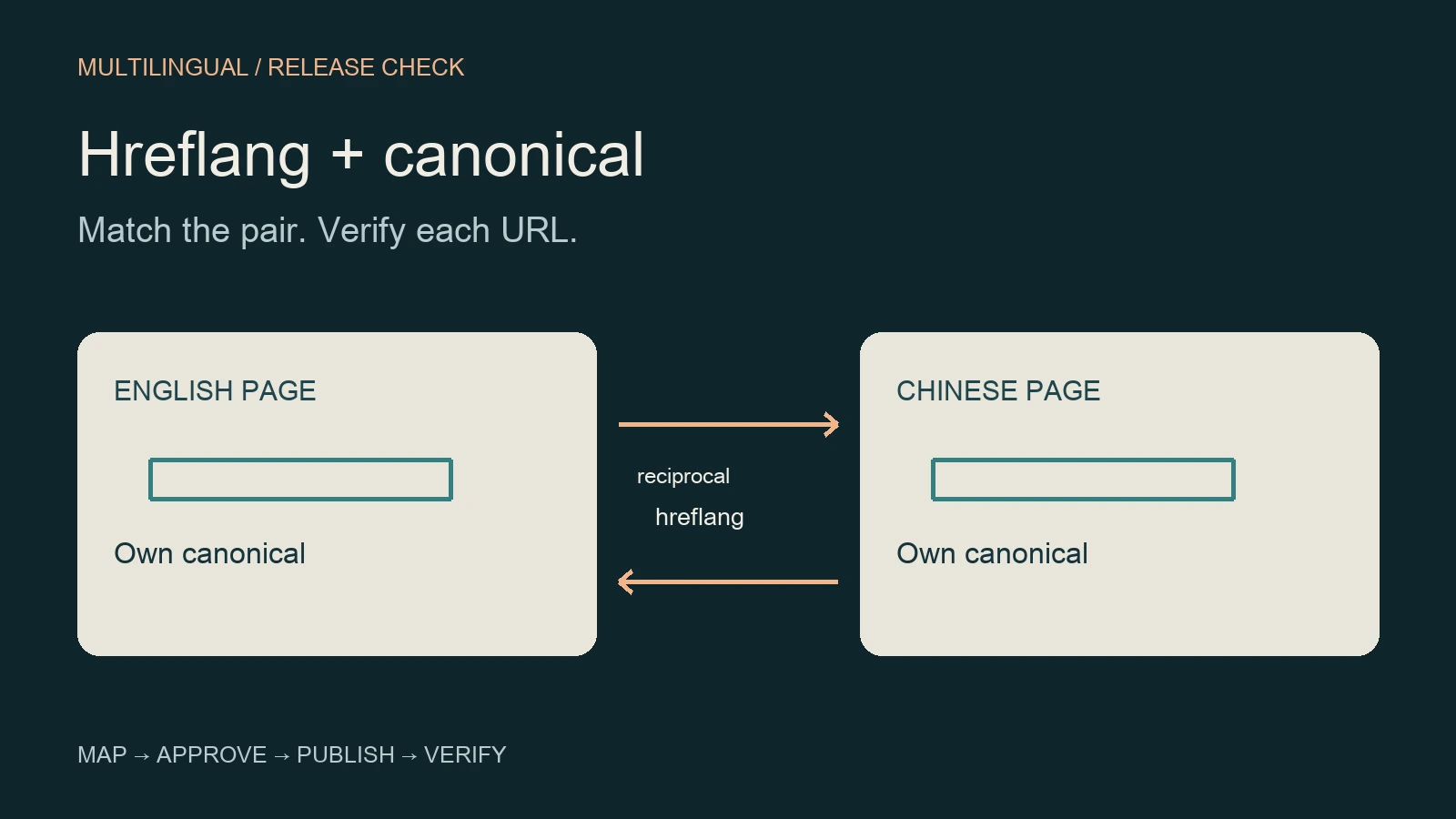
Hreflang identifies equivalent language or regional versions of a page. A canonical identifies the preferred URL among duplicate or very similar pages. For fully translated English and Chinese pages intended for Search, a practical starting point is a self-canonical for each page and reciprocal hreflang between the published equivalents.
A B2B team adding a second language needs a page-pair decision before it needs another plugin setting. This guide helps a marketing owner and developer agree which service pages correspond, inspect their public output, and record what still needs verification in Google Search Console.
Hreflang vs canonical: two decisions
The useful question is whether the URLs represent duplicates, localized equivalents, or different buyer tasks. Google’s canonicalization guidance explains that translated pages are treated as duplicates only when their main content remains in the same language. Translating navigation while leaving the service description unchanged is different from translating the whole page.
A canonical is a preference signal; Google can select another URL. It does not replace a language relationship, remove a page from the server, or act as a redirect. Google’s canonical implementation guidance recommends a canonical in the same language when using hreflang, with a substitute-language exception when that is unavailable.
For the translated service-page workflow below, use one intended canonical per language. Keep the business decision explicit: “English visitors should be able to evaluate this service in English, and Chinese visitors should be able to evaluate its equivalent in Chinese.” A blanket rule pointing every translation to the English homepage does not express that decision.
Map equivalent buyer pages first
Create a short mapping before generating tags. Use the buyer’s question as the join key: the English service overview and its Chinese adaptation may be equivalents; the English service overview and a Chinese campaign landing page may serve different purposes. Similar slugs alone are weak evidence of equivalence.
- Record both final URLs, page purpose, owner and translation approval state.
- Compare the main answer, service scope, supporting sources and onward action. Review differences that change the decision a reader can make.
- Use the matching translated page when it exists. Do not point every article’s alternate at the other language’s homepage.
- If a translation is still a draft, keep it outside the public language pair until it is approved, accessible and checked. This is a release-control recommendation.
For permanent service content, use the service-page content worksheet to establish the answer before mapping languages. Where the whole URL structure is changing, retain the broader SEO migration checklist for redirects and launch baselines.
An English and Chinese example
Hypothetical example: an industrial supplier has an English inspection-service page and a fully translated Chinese equivalent. Both URLs below are placeholders on example.com. These snippets belong in each page’s HTML head; they are not a configuration to paste unchanged into a live site.
English page head
<link rel="canonical"
 href="https://example.com/inspection/" />
<link rel="alternate" hreflang="en"
 href="https://example.com/inspection/" />
<link rel="alternate" hreflang="zh-CN"
 href="https://example.com/zh/inspection/" />
<link rel="alternate" hreflang="x-default"
 href="https://example.com/inspection/" />
Chinese page head
<link rel="canonical"
 href="https://example.com/zh/inspection/" />
<link rel="alternate" hreflang="en"
 href="https://example.com/inspection/" />
<link rel="alternate" hreflang="zh-CN"
 href="https://example.com/zh/inspection/" />
<link rel="alternate" hreflang="x-default"
 href="https://example.com/inspection/" />
The alternate set is the same on both pages; the canonical changes to that page’s own URL. Google’s localized-version documentation calls for fully qualified alternate URLs, self-inclusion and return links. HTML, HTTP headers and XML Sitemap annotations are equivalent hreflang methods; choose a maintainable method rather than duplicating work for an assumed Search benefit.
Ask the developer which component owns the output. A language plugin, SEO plugin and theme can each generate tags. Assign one implementation owner and inspect the resulting head after caching, instead of treating three checked settings as three successful validations.
Choose language codes and a fallback
Use a language code first, with a region only when the page deliberately targets it. Google documents en, en-GB, zh-CN and script forms such as zh-Hans. A country code alone is insufficient. x-default describes the fallback for unmatched languages; it is not a language code or a command that makes English outrank Chinese. See the supported codes and fallback rules.
In the example, English is the chosen fallback because that is the hypothetical site’s supported onward route. Your team might choose a language selector instead. Record why the fallback remains useful for someone whose language is unsupported, and test that person’s next action. Do not choose a fallback simply because a plugin selected it.
Diagnose conflicts in the right order
Start with one affected pair rather than changing the entire site. Save both current heads, response headers and final URLs. Compare the observed state with the approved mapping. The following sequence is a suggested troubleshooting workflow; it separates a content decision from an implementation failure.
| Observed symptom | First check | Reviewable correction |
|---|---|---|
| Chinese page names English as canonical | Is the Chinese main content fully translated? | If independent translated content is intended, prepare its own canonical and check the paired signals. |
| Only one page names the other as alternate | Read the other page’s actual head | Restore the missing return relationship to the final equivalent URL. |
| Alternate redirects or reaches a homepage | Follow the URL as a visitor | Use the final matching page; keep redirect decisions in the migration map. |
| Two canonical tags disagree | Compare theme, SEO and language output | Resolve the competing generators and verify one intended canonical. |
| Page has noindex or cannot be fetched | Read response and robots settings | Resolve publication eligibility before evaluating locale selection. |
| Tags look correct but Google selects another URL | Check indexed URL Inspection evidence | Investigate the selected URL and source content; retain the observation date. |
Inspect robots meta and HTTP headers together: a visible index value does not cancel a conflicting noindex. Google explains this in its robots rules reference. If the problem concerns a broader crawl-control choice, use the Googlebot and Google-Extended control guide rather than attempting to solve it with hreflang.
Handle same-language regional duplicates separately
An English page for the US and a nearly identical English page for the UK require a separate duplication decision. They are not the same problem as an English page and a fully translated Chinese page. Google’s multi-regional site guidance discusses using canonical and hreflang together for similar same-language regional content.
Before creating another regional URL, ask what changes for the buyer: availability, terminology, local proof or a genuinely different service scope. If the only difference is a country label in the footer, record the duplicate-content question rather than automatically applying the translated-page example. Ask the technical reviewer to document the preferred same-language URL and the intended regional alternatives.
Keep a language switch available to visitors. Google recommends distinct language URLs and warns against automatically redirecting people based on assumed language. Test the route without a remembered preference as well as after selecting a language. An export buyer following a shared Chinese URL should be able to read that page and choose another supported language.
Copy this language-pair acceptance record
Copy this record into the release ticket. Fill it for each buyer-critical pair, not just the homepages. Assign the implementer and verifier separately where practical, so the person checking output has a clear expected result rather than a vague “multilingual SEO complete” task.
- Pair ID / buyer question: ____
- English final URL / Chinese final URL / intended fallback: ____
- Equivalent main answer and scope checked by / date: ____
- Approved source revision / translation reviewer / candidate version: ____
- Expected canonical on each page / complete alternate set: ____
- Observed HTTP status / redirect destination / robots meta / X-Robots-Tag: ____
- Public head evidence and capture time for each URL: ____
- Rendered language-switch destination and mobile result: ____
- Indexed URL Inspection: crawl date / user-declared canonical / Google-selected canonical / Unknown reason: ____
- Rollback artifact / implementer / independent verifier / unresolved exception: ____
A useful failure record is specific: “Chinese service page names the English URL as canonical; the approved map requires a Chinese self-canonical; current heads attached.” That can be reviewed and retested. “International SEO is broken” cannot tell the developer what to change.
Release the pair and verify what changed
Before release, retain the previous mapping and affected outputs. Test one representative pair, then apply the same approved pattern to the intended set. After relevant cache clearing, inspect ordinary public URLs, the canonical and alternate output, links and mobile language selection. Compare what is delivered with the ticket; a successful CMS save only verifies the save.
Then inspect Google’s processed state separately. Search Console URL Inspection help distinguishes indexed data from a live test: the live test cannot predict Google’s selected canonical. Record the crawl date and both canonical fields from indexed evidence when available. A newly published translation can be technically accessible while Google’s processing remains unknown.
For ongoing follow-up, add the pair to the B2B SEO monitoring system. Watch the intended URLs and relevant query-language patterns over documented windows. Do not repeatedly change correct tags because a new page has not yet produced clicks. Use the saved acceptance record to decide whether there is an implementation defect or simply an unanswered performance question.
Frequently asked questions
Should every translation canonicalize to English?
For fully translated pages intended to stand on their own in Search, use a canonical in each page’s language and connect equivalent versions with hreflang. Review same-language duplicates separately. A global English canonical should not be applied merely because English was the original drafting language.
Is x-default required for every page?
Google recommends x-default for unmatched languages, especially on language selectors or redirecting homepages. It is a fallback choice, not a universal requirement for indexability. Choose a useful supported destination and document it in the page-pair map rather than treating the value as a ranking switch.
Can hreflang fix a noindex page?
No. Language annotations do not remove a noindex rule. Check whether the translated page is meant to be public and indexable, inspect robots meta and response headers, and resolve that eligibility decision first. Then verify its language relationship with the intended equivalent page.
Do we need hreflang in HTML and the Sitemap?
Google treats HTML, HTTP headers and Sitemap hreflang as equivalent methods. One maintained method can be enough. If your site already uses several, compare their outputs and remove conflicts through a reviewed change. Extra copies of inconsistent mappings create more places to investigate when a pair changes.
Sources and next steps
Primary sources checked on 24 October 2026: localized versions; canonical implementation; canonical selection; multi-regional sites; URL Inspection; robots meta and headers.
Hreflang vs canonical becomes a manageable release decision when the equivalent pages, preferred URLs and expected output are written down. Explore the SEO / GEO Authority cluster for related implementation guides. If your team needs help locating a language-pair conflict, request a website diagnostic with the affected public URLs and the acceptance record.