

I took over the English-language SEO project for a paper-products and packaging-printing manufacturer in May 2026 and continued the work through October. The business had substantial production capability, but its supporting content focused on only a small part of its catalogue. I completed work across product-range content, image descriptions, internal links and technical issues.
The initial Semrush monthly organic traffic estimate was in single digits. The overview screenshot supplied for this case shows 519 estimated organic traffic and approximately 1K organic keywords. The May–October trend shows an overall rise, with fluctuations and recent continued growth. Under the confidentiality agreement, I am withholding the client name and website address while retaining its business background.
Packaging manufacturer SEO project at a glance
| Item | Project information |
|---|---|
| Period | May–October 2026; optimisation and observation are ongoing |
| Client | B2B paper-products and packaging-printing manufacturer offering OEM/ODM custom production |
| Markets | Primarily Singapore and Malaysia; also Hong Kong, Macau, Taiwan and other markets |
| Completed work | Content across nine ranges, alt text for 500+ images, URL correction, structured data, market content, publishing cadence and product links |
| Evidence | Owner-supplied Semrush trend and overview screenshots; traffic values are third-party estimates |
Client background: production capability across nine product ranges
The client operates an approximately 8,000-square-metre facility in Nanhai District, Foshan, Guangdong, with more than 100 employees, dedicated R&D and design staff, a Heidelberg six-colour printing press and automated production lines. It provides OEM and ODM manufacturing rather than trading services.
Its nine ranges include red envelopes, envelopes, paper bags, gift boxes, folders, document bags, flyers, sleeves and stickers. The English-language website serves buyers in Singapore and Malaysia, with additional audiences in Hong Kong, Macau and Taiwan and potential markets in Vietnam and Indonesia.
What did I find when I took over?
The initial project record listed 42 indexed pages: 38 product pages and four blog articles, all about red envelopes. The other eight product ranges had product pages but little supporting buying, comparison or application content.
The existing product information was useful. The red-envelope page already described shapes, printing methods, finishes and paper options. I worked from that foundation, extending buying guidance across the catalogue rather than rewriting every page.
- Images: many of the site’s 500+ product images lacked useful alt text.
- Market coverage: editorial content concentrated on Singapore despite a wider intended audience.
- Publishing and links: a short burst of articles had been followed by a long gap, and related products lacked contextual links.
- Technical details: I recorded a misspelled indexed URL, repeated homepage-title wording, structured-data gaps and indexing-control issues for non-content pages.
What optimisation work did I complete between May and October?
The following actions come from my project execution record and describe work I completed in this project. They shared the goal of helping buyers find, understand and compare the manufacturer’s products and custom services.
- Extended blog coverage across all nine ranges. I organised three to five core articles per range around buying guides, supplier comparisons and design topics, connecting them with relevant product pages.
- Added descriptive alt text to 500+ product images. Descriptions reflected the actual products, materials and finishes rather than repeating the same keywords.
- Corrected a misspelled URL and added a 301 redirect. I connected the old address with its replacement; the client’s specific addresses are withheld.
- Added structured data. I implemented Product markup for product pages, FAQPage for blog questions and answers, and LocalBusiness for business information.
- Added market-specific content. I completed three to five articles each for Malaysia, Hong Kong and Taiwan to address local buying terminology and needs.
- Established a cadence of two to four articles per month. Publishing became a continuing activity rather than an isolated burst.
- Added Related Products modules. Product pages gained connections to relevant packaging options.
- Fixed repeated wording in the homepage Title template. I revised the configuration to express the page topic more clearly.
- Handled indexing controls for non-content pages. Thank-you pages and similar pages were included in robots and noindex work.
Content answers buying questions, image descriptions add semantic and accessibility information, and internal links connect product choices. Google’s image guidance explains that alt text works with page context; its structured-data policies make clear that valid markup does not guarantee rich results.
Technical context: FAQPage is retained here as work I actually performed, but not as a current Google rich-result benefit: Google has discontinued FAQ rich results. A noindex instruction also needs to remain readable by crawlers; robots.txt blocking can prevent that, as explained in Google’s indexing-control guidance.
Project timeline: May to October 2026
| Stage | Work and observations |
|---|---|
| May 2026 | I took over, reviewed the product catalogue, content and technical issues; the initial organic traffic estimate was in single digits |
| May–October 2026 | I completed content expansion, image descriptions, market articles, product links and technical work; individual completion dates are not listed |
| October 2026 case review | I supplied the trend and overview screenshots; the overall trend rose and the project remains ongoing |
Results: 519 estimated organic traffic and approximately 1K keywords
I used Semrush to track organic search performance. The initial single-digit estimate, the previously observed monthly range of approximately 300–500, and the overview figure of 519 show the progress I have observed. The overview displays organic keywords as 1K, an approximate rather than exact count.
| Metric | Reported figure | Evidence and definition |
|---|---|---|
| Initial organic traffic | Single digits | My initial project record; no exact early tooltip value is shown |
| Organic traffic overview | 519 | Supplied Semrush Organic Traffic screenshot; third-party estimate |
| Organic keywords | Approximately 1K | Rounded display value in the supplied overview |
| May–October trend | Overall rise with interim dips and recent growth | Six-month Semrush chart with Days selected |
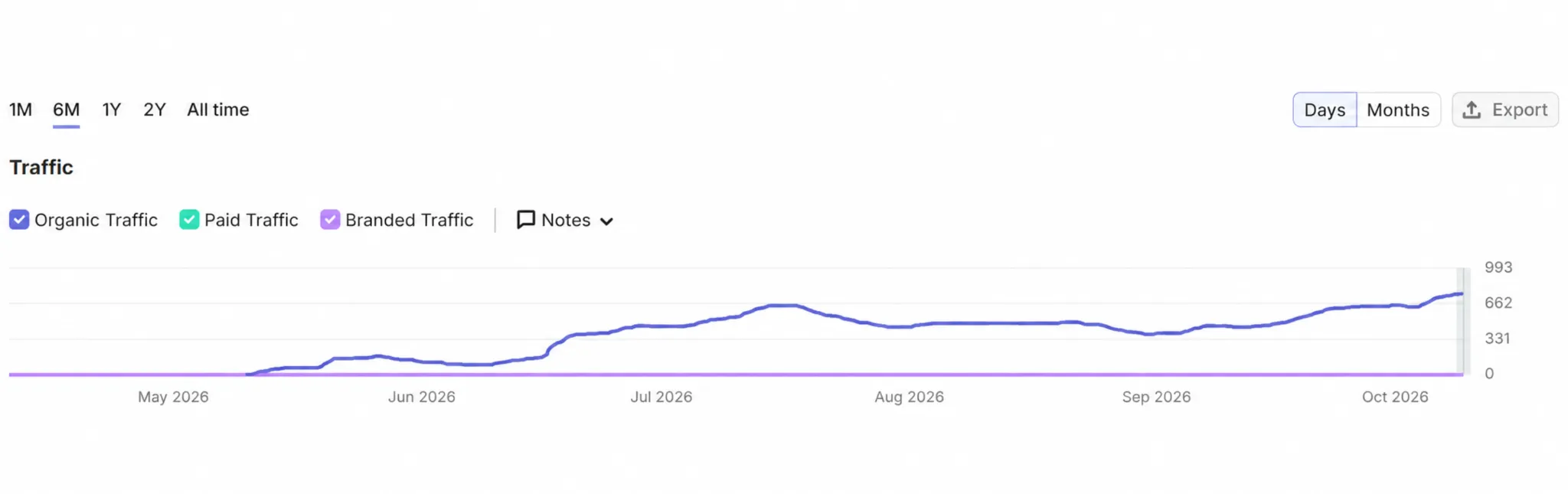
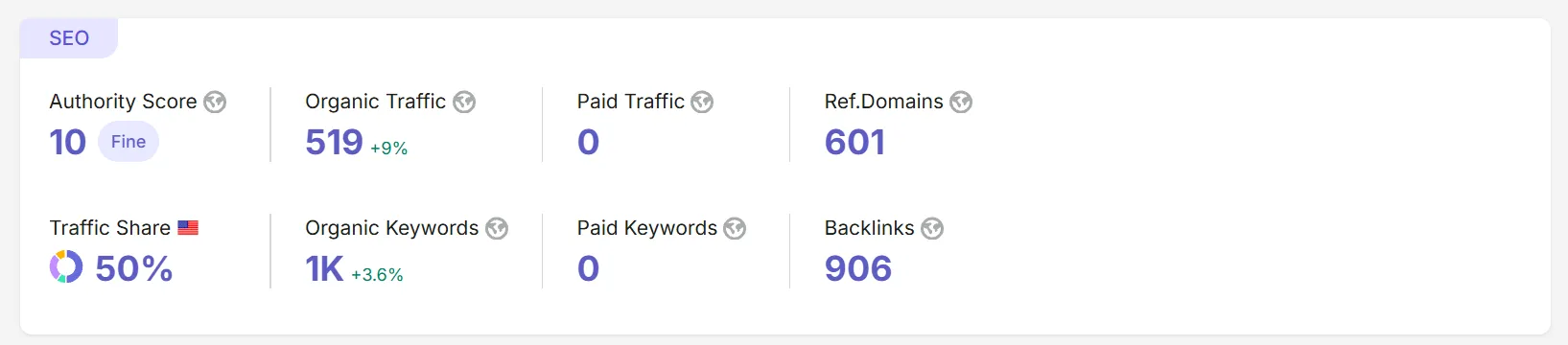
Reading the evidence: the screenshots do not display the complete database, device scope or capture date. I therefore cite the trend and overview separately, do not equate their endpoint values, and do not use the displayed percentage changes as cumulative project growth. These estimates are not measured GA4 visits, Search Console clicks or qualified inquiries. Original planning forecasts are excluded, and I am not attributing the change to a single action.
What can another manufacturer take from this case?
My main lesson is to build buying guidance around the full catalogue. Product pages describe manufacturing capability; supporting articles explain materials, finishes, selection and market needs; images and internal links help buyers continue their evaluation.
For another B2B business with several product ranges and substantial product information but limited search coverage, I would first check whether supporting content serves only a few categories, then prioritise the missing buying questions and page connections.
Questions this case answers
Why add articles when product pages are already detailed? Here, product detail was substantial, but articles supported only red envelopes. I extended buying, comparison and design content to the other ranges so buyers could find answers before selecting a product or requesting a quote.
Does adding alt text to 500+ images prove image-search growth? I completed the image-description work, but the evidence here concerns overall estimated organic traffic. Demonstrating a separate image-search gain would require image-search data, so I do not make that attribution.
Does the figure of 519 mean actual monthly visitors? No. It is the Semrush Organic Traffic estimate, not a count recorded by the website. I use it to document the tool’s observed organic search trend.
Want case details closer to your industry or goals?
Contact me if you would like more detail about this project’s content structure, execution or results. You can also tell me your industry, target market and the website or SEO problem you most want to solve.
Using the project material I can share, I can discuss relevant case details and optimisation approaches with you, helping you assess whether my method fits your business and where we could begin working together. Client information is shared within confidentiality limits.
You can also explore my B2B SEO audit approach.