

AI content governance is not a document that sits beside the marketing workflow. It is the workflow: the decisions, evidence, permissions, review gates, and records that determine whether an AI-assisted output can move from an idea to a published asset.
This distinction matters for B2B marketing. A polished draft can still contain an unsupported claim, expose information that was not approved for external use, blur a real expert’s opinion into generic language, or create a new page that competes with an existing canonical owner. A prompt library alone does not control any of those outcomes.
The practical goal is not to remove humans from content production. It is to assign machines and people to the decisions each can handle, make uncertainty visible, and prevent a draft from reaching a live system before its evidence and authority are clear.
What AI content governance needs to control
A useful governance model controls five things before it controls tools:
- Purpose: the buyer question and business decision the content should support.
- Evidence: the sources, approved experience, and assumptions behind each material claim.
- Authority: who may draft, review, approve, publish, revise, and retire the asset.
- Exposure: what information may be sent to a model or made public.
- Change: what was generated, what a person changed, which version was approved, and what happened after release.
NIST’s Generative AI Profile is a voluntary, cross-sector companion to the AI Risk Management Framework. It emphasizes governance, content provenance, pre-deployment testing, and incident disclosure. It also describes confabulation—the confident production of false or internally inconsistent output—as an inherent risk of generative systems. For a marketing team, the operational implication is straightforward: fluent text is not evidence, and a successful generation is not a release decision.
Start with decision rights, not a list of approved prompts
The first governance artifact should be a decision-rights map. It tells the team which work can move automatically, which work requires a named reviewer, and which work must stop until an accountable person supplies missing evidence or approval.
| Work type | AI may assist with | Human decision |
|---|---|---|
| Research preparation | Organizing known sources, extracting questions, proposing gaps | Whether the sources are authoritative, current, and relevant |
| Draft production | Structure, alternatives, summaries, formatting | Point of view, factual acceptance, brand meaning, and final wording |
| SEO implementation | Metadata drafts, link suggestions, schema checks | Canonical ownership, search intent, and whether a new URL should exist |
| Publication | Preparing a validated request and running deterministic checks | Approval for protected claims and permission to make the asset public |
| Maintenance | Flagging stale sources, broken links, and metadata drift | Whether to refresh, consolidate, redirect, or retire the asset |
This map should be based on consequence and uncertainty, not on whether a task feels easy. A repetitive metadata correction may be low-risk and reversible. A short sentence about a customer, a result, a commitment, or an expert’s personal experience may carry much greater consequence even though it takes seconds to write.
The evidence-gated content workflow
The following workflow treats publication as the result of passing explicit evidence and authority gates. It can be implemented in a spreadsheet, a project-management system, or a content platform. The control logic matters more than the software.
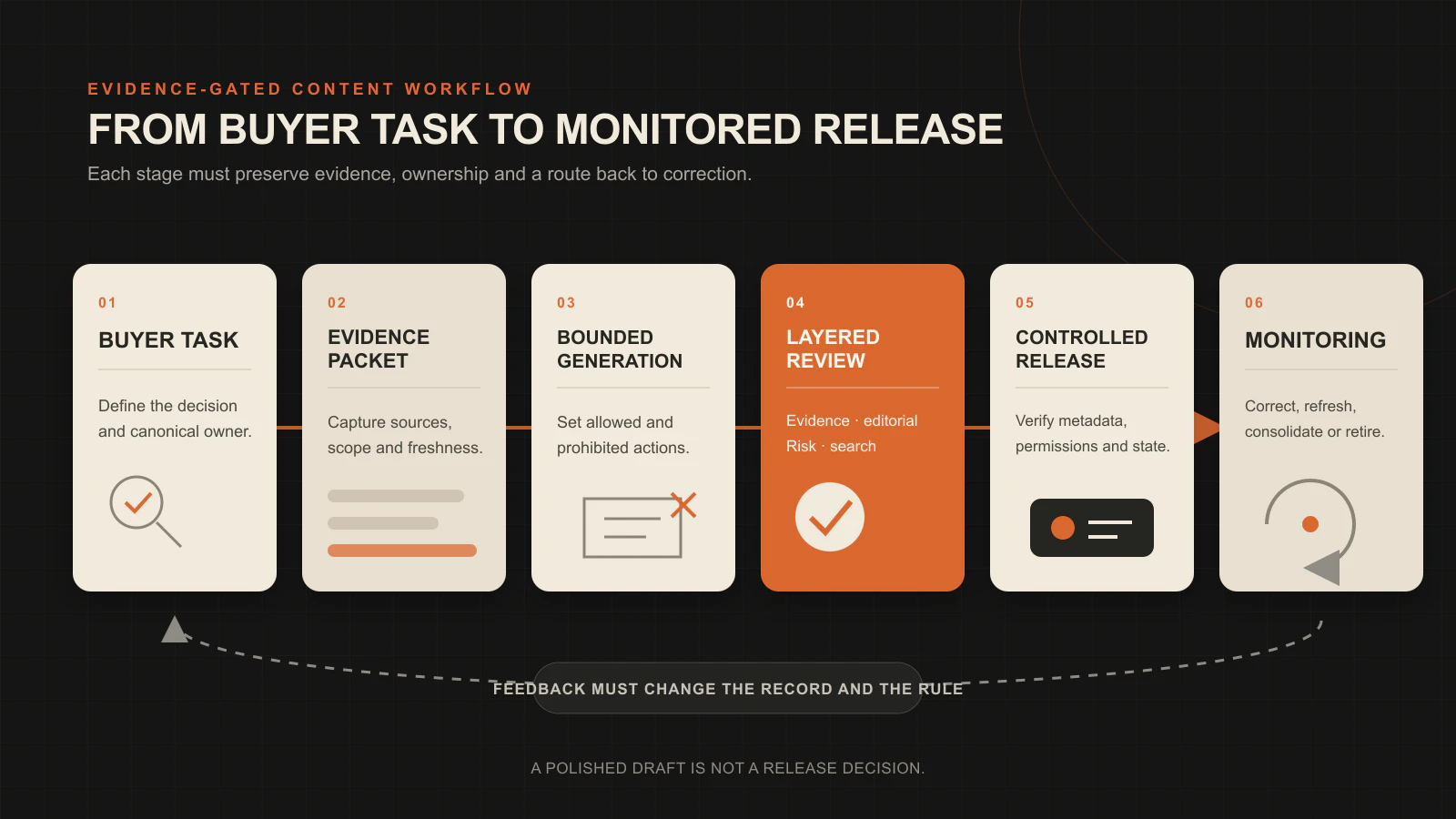
Stage 1: Define the buyer task and canonical owner
Write a one-sentence intent statement before collecting keywords or generating an outline:
This asset helps [specific role] decide [specific decision] when [specific context].
Then identify the current page that owns the intent. The correct action may be to improve that page, add a supporting section, consolidate overlap, or create a distinct resource. A related phrase is not enough reason for a new URL. CHCZ uses the same principle in its B2B website audit framework: establish the evidence and decision before choosing the visual or technical intervention.
Stage 2: Build an evidence packet
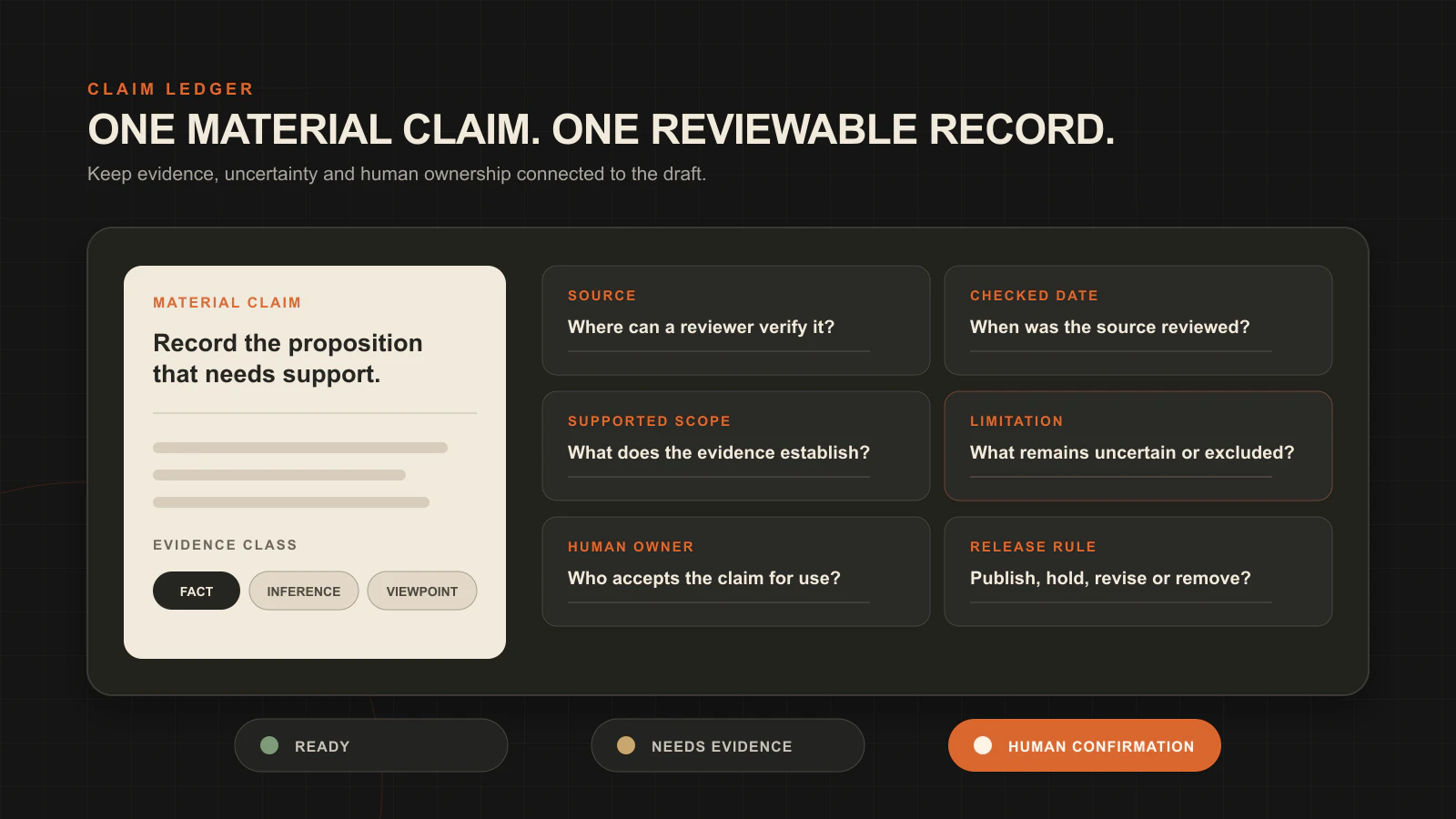
Give the drafting system a bounded evidence packet rather than an open request to “research the topic.” The packet should include the source URL, publisher, date checked, the exact proposition the source supports, and any limitation that changes how the claim may be written.
| Field | Question it answers |
|---|---|
| Claim ID | Which statement is being supported? |
| Source | Where can a reviewer verify it? |
| Checked date | How fresh is the verification? |
| Evidence class | Is this a fact, inference, or viewpoint? |
| Scope | What does the source support—and what does it not support? |
| Owner | Who accepts responsibility for using the claim? |
NIST recommends recording provenance information such as sources, timestamps, metadata, versions, known issues, and human oversight roles. The marketing version of that practice is a claim ledger connected to the draft. It does not prove that every statement is true, but it makes the basis of each important statement inspectable.
Stage 3: Generate inside explicit boundaries
The generation brief should specify what the system may do, what it must preserve, and what it must never invent. Useful boundaries include:
- Use only the supplied sources for factual assertions.
- Label unsupported possibilities as questions or remove them.
- Do not create customers, quotations, results, credentials, or first-hand experience.
- Do not change approved positioning, commitments, or legal text.
- Preserve the difference between fact, inference, and editorial viewpoint.
- Return unresolved claims in a review queue instead of smoothing over the gap.
Google’s guidance on generative AI content says that generative tools can help with research and structure, while automatically generating many pages without added value may violate its scaled-content policies. Google also advises publishers to focus on accuracy, quality, and relevance across the page and its metadata. The governance lesson is not “avoid AI.” It is “make value and accountability observable before scale.”
Stage 4: Review in layers
A single “approved” checkbox hides too much. Separate review into layers so the responsible person knows what they are accepting:
- Evidence review: Do the sources support the material claims, and are limitations visible?
- Editorial review: Does the asset solve the buyer task completely, preserve a real point of view, and avoid generic filler?
- Risk review: Does it contain protected information, sensitive data, commitments, or claims that require specialist approval?
- Search review: Is the intent distinct, the canonical owner clear, and the internal-link role deliberate?
- Release review: Do the final title, description, canonical, author, schema, images, links, and indexability match the approved state?
Google’s people-first content guidance asks whether a page offers original information or analysis, provides enough substance for the reader to achieve a goal, explains who created it, and adds value rather than merely summarizing other sources. Those questions are useful acceptance criteria. They are not a substitute for subject-matter review, but they help prevent the workflow from treating grammatical polish as quality.
Stage 5: Publish through a controlled release path
The final publishing mechanism should enforce the same rules the editorial policy describes. If a protected claim is present, the system should hold the asset for review rather than depend on the operator to remember a checklist. If a request is retried, an idempotency control should update or return the intended asset instead of creating a duplicate. If SEO fields are required, the release request should carry them explicitly and verify the stored values after the write.
Controlled publishing is strongest when three layers agree:
- Policy: the documented rule for what may be automated.
- Mechanism: the technical gate that blocks or routes exceptions.
- Evidence: the audit record showing what was requested, approved, stored, and exposed publicly.
This is an inference from risk-management and publishing principles, not a claim that one architecture fits every organization. Teams should make the gate proportional to the consequence of the content and the systems it can change.
Stage 6: Monitor, correct, and retire
Governance continues after publication. Monitor whether the live asset matches the approved version, whether sources become stale, whether queries begin mapping to the wrong page, whether corrections are reported, and whether the content still supports its intended buyer decision.
The NIST profile recommends iterative testing, documented evaluation, monitoring, feedback, and escalation. In content operations, that means keeping the route back from observation to revision. A correction should not disappear into an informal chat; it should update the claim record, the asset version, and the rule that allowed the issue through.
What should remain human-owned
Automation can check whether a citation exists. It cannot accept responsibility for whether the source is sufficient in context. It can detect that a page contains a number. It cannot decide whether the number creates an inappropriate expectation. It can compare a title with a stored field. It cannot decide whether the title expresses the brand’s real position.
A useful rule is to keep humans responsible for decisions that require accountable judgment:
- original viewpoints and strategic recommendations;
- claims based on personal or organizational experience;
- customer, partner, and confidential information;
- commercial commitments and statements that can change buyer expectations;
- high-consequence health, finance, safety, employment, or regulatory content;
- final approval when the asset can create an external action or change a live system.
OpenAI’s 2026 enterprise guide describes a similar operating direction: organizations that scale AI successfully define quality early, redesign workflows rather than merely distribute tools, and use hybrid systems that preserve expert reasoning and review. That source reports patterns from interviews; it does not establish a universal causal rule. The practical inference is that governance should protect judgment work instead of adding a generic human signature at the end.
A minimum viable governance record
A team can begin without buying a governance platform. For each AI-assisted asset, retain:
- the buyer task and intended canonical owner;
- the approved source packet and checked dates;
- the claim ledger, including unresolved items;
- the model’s assigned role and prohibited actions;
- the named human owners for evidence, editorial, risk, and release decisions;
- the final approved version and material changes;
- the publication request, stored metadata, and live QA result;
- the review date, correction route, and retirement condition.
For media assets, provenance can extend beyond an internal record. The C2PA specification defines technical standards for recording the origin and history of media through Content Credentials. C2PA also makes an important distinction: provenance records history; they do not make a value judgment that the content itself is true. That is why source records, review, and accountable approval still matter.
How to judge whether the workflow is improving
Do not evaluate the system only by the number of drafts or the speed of production. Those measures reward output even when review debt and duplication are growing. Instead, watch operational signals such as:
- material claims with a valid evidence record;
- protected items correctly held before publication;
- duplicate intents caught before a new URL is created;
- review exceptions and the time required to resolve them;
- post-publication corrections and their root causes;
- assets refreshed or retired when evidence changes;
- buyer actions that the content was intended to support.
The choice of metrics is an editorial viewpoint. The principle behind it is that a governed workflow should improve decision quality and traceability, not merely increase throughput.
Source and reasoning notes
| Statement | Evidence class | Basis |
|---|---|---|
| Generative systems can produce confident false or inconsistent output. | Fact | NIST AI 600-1 discussion of confabulation. |
| Governance, provenance, pre-deployment testing, and incident disclosure are relevant control areas. | Fact | NIST Generative AI Profile. |
| AI-assisted web content should be accurate, useful, and add value rather than be generated at scale for search manipulation. | Fact about Google’s published guidance | Google Search Central documentation. |
| A claim ledger is a useful marketing adaptation of provenance practice. | Inference | Derived from NIST provenance and documentation actions. |
| Publication should be treated as a gated release rather than the final drafting step. | Editorial viewpoint | CHCZ framework proposed in this article. |
| Content Credentials can record media provenance but do not independently prove truth. | Fact | C2PA specification and explainer. |
Build the smallest gate that can stop the wrong release
AI content governance becomes useful when it changes what the system can do. Begin with one workflow, one buyer task, a bounded source packet, named decision owners, and a publishing gate that can hold an unresolved asset. Record what happens, then strengthen the rule where real exceptions appear.
That approach is slower than pressing “publish” on every plausible draft and faster than repairing an untraceable content operation later. To connect the workflow with broader discoverability and website decisions, explore the staged AI Marketing Systems cluster, the guide to generative engine optimization, or request a B2B growth diagnostic.